
 Available in GB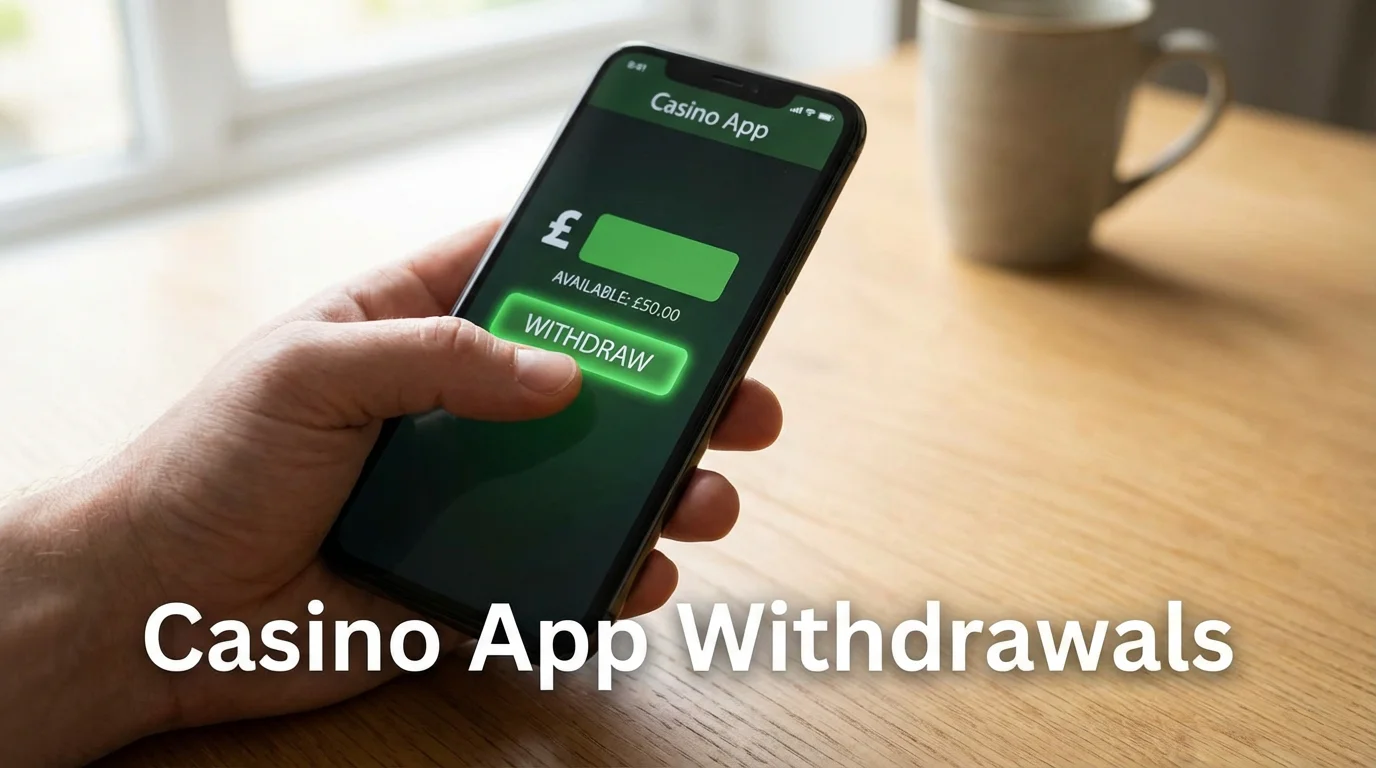
Your Winnings Are Only Real When They’re in Your Account
A balance on a casino app screen is not money. It is a number that represents a promise — a promise that the operator will convert those digits into actual pounds in your bank account, PayPal wallet, or e-wallet when you ask. Until that conversion happens, your winnings exist only within the operator’s system, subject to their processing times, verification requirements, and terms of service. The withdrawal process is where that promise gets tested.
For UK players at UKGC-licensed apps, the process is generally reliable. Operators are legally obligated to process legitimate withdrawal requests, and regulatory oversight means that outright refusals to pay are rare among licensed platforms. But “reliable” does not mean “instant” or “effortless.” Withdrawal speed, method availability, and verification requirements vary significantly between operators, and the difference between a well-handled payout and a frustrating one often comes down to preparation — specifically, what you do before you ever hit the withdraw button.
Step-by-Step Withdrawal Process
The mechanics are consistent across virtually all UKGC-licensed casino apps, with minor interface variations. Here is what to expect.
Open the cashier. Navigate to the banking, wallet, or cashier section of the app. On most platforms, this is accessible from the main menu or via an icon in the top-right corner of the screen. Some apps label it “Withdraw” directly; others group it under “My Account” or “Banking.”
Select your withdrawal method. You will see a list of available payment methods. If you deposited via PayPal, your withdrawal will typically be routed back to PayPal under the Closed Loop policy — an anti-money-laundering requirement that returns funds to the same source they came from. If you deposited via debit card, you will usually withdraw to that same card. Some operators allow you to choose an alternative method for amounts exceeding your total deposits, but the default is always the original deposit method first.
Enter the amount. Minimum withdrawal thresholds vary by operator and method — £10 is standard for e-wallets, £20 for debit cards and bank transfers at many platforms. Maximum single-transaction limits also apply, typically between £2,000 and £10,000, though VIP players may have higher caps. Enter the amount within these bounds and confirm.
Confirm and wait. After submitting, the withdrawal enters a processing queue. Most operators display a “pending” status during their internal review, which can last anywhere from a few minutes to 48 hours depending on the operator, the amount, and whether additional verification is required. Some apps still include a “pending period” during which you can reverse the withdrawal — a practice the UKGC has discouraged but not entirely banned. If you see a “cancel withdrawal” button, ignore it. That button exists to keep your money in the casino, not to help you.
Internal processing completes. Once the operator approves the withdrawal, the funds are released to your chosen payment method. The time from approval to arrival in your account depends entirely on the method: e-wallets like PayPal receive funds almost instantly, debit cards take one to three business days, and bank transfers can take three to five. The operator’s role ends at approval; everything after that is between your payment provider and your bank.
One step that should happen before all of this: identity verification. If you have not yet completed KYC (Know Your Customer) checks, your first withdrawal will trigger them. The operator will ask you to upload proof of identity (passport, driving licence), proof of address (utility bill, bank statement), and potentially proof of your payment method (screenshot of e-wallet, photo of card). This process can add hours or days to your first withdrawal if you are not prepared for it. Complete KYC immediately after registration — before you even start playing — and this bottleneck disappears entirely.
Best Withdrawal Methods Ranked
The method you choose determines how quickly your money arrives after the operator hits “approve.” Here is how the main options compare for UK players.
PayPal is the fastest widely available option. Once the operator releases the funds, PayPal credits your wallet within minutes — often instantly. From your PayPal balance, you can transfer to your bank account (usually same day) or spend the funds directly using your PayPal account. Combined with operator-side processing, total time from withdrawal request to accessible funds is typically two to six hours at well-run platforms.
Skrill and Neteller match PayPal on speed. Funds arrive in your e-wallet within minutes of operator approval. The trade-off is that both are less useful outside of gambling — higher fees for everyday purchases, fewer retail merchants that accept them, and a reputation that some banks treat with suspicion when it comes to mortgage applications and credit checks. For pure gambling-to-bank speed, they are excellent. For everyday utility, PayPal is more versatile.
Visa debit withdrawals take one to three business days after operator approval. The Visa Direct network has accelerated this at some operators to same-day or next-day, but the improvement is inconsistent. Visa is universal — every UK player with a bank account has a debit card — which makes it the default fallback for players without an e-wallet. The delay is the price of that universality.
Mastercard debit presents a wrinkle. While Mastercard deposits are accepted everywhere, not all operators support Mastercard withdrawals. Those that do typically process them on the same one-to-three-day timeline as Visa. Check withdrawal availability before depositing with Mastercard, or you may find your payout routed to a bank transfer instead.
Bank transfer is the slowest standard option, taking three to five business days after approval. The advantage is that bank transfers typically carry the highest per-transaction limits, making them the practical choice for large withdrawals. Some operators offer “fast bank transfer” options that claim to reduce this to one to two days, but the improvement depends on both the operator’s banking partner and your own bank’s processing speed.
Why Withdrawals Get Stuck — And How to Fix It
When a withdrawal takes longer than expected, the cause almost always falls into one of four categories. Identifying which one applies to your situation determines how to resolve it.
Incomplete KYC verification is the most common reason for first-withdrawal delays. If the operator has not yet verified your identity, your withdrawal will sit in the queue until you provide the required documents and a member of the compliance team reviews them. The fix is prevention: submit your documents immediately after registration. Upload clear, high-resolution photos of your ID and proof of address. Blurry images, expired documents, or mismatched names between your casino account and your ID are the most frequent causes of rejection, which sends you back to the start of the queue.
Unmet wagering requirements on bonus funds will prevent withdrawal of those funds. If you accepted a bonus and have not yet cleared the wagering conditions, the bonus balance and any associated winnings remain locked. Your own deposited funds should still be withdrawable — UKGC rules require this — but the bonus portion will not release until wagering is complete. Check your bonus status in the app’s promotions section. If the wagering is close to complete, it may be worth finishing it. If it is far off, consider forfeiting the bonus to release your cash balance.
Operator processing delays occasionally extend beyond the stated timeframe. Most UKGC-licensed apps advertise processing times of 24 to 48 hours for internal review. If your withdrawal has been pending for longer than this without any communication, contact customer support. Start with live chat — it is faster than email and creates a written record of your enquiry. If live chat cannot resolve the issue, escalate by requesting a formal complaint reference number. Operators are required to acknowledge formal complaints and provide a response within eight weeks under UKGC rules. If the complaint remains unresolved, you can escalate to the operator’s designated Alternative Dispute Resolution (ADR) provider, whose details must be listed on the casino’s website.
Source of Funds checks apply when your deposits or winnings exceed certain thresholds. Under UKGC rules, operators must conduct enhanced due diligence when a customer deposits or loses more than £150 within a rolling 24-hour period. These checks may require you to provide evidence of your income — payslips, bank statements, tax returns — to demonstrate that your gambling expenditure is affordable. The process can take several days, and your withdrawal will remain on hold until the check is complete. Cooperating promptly with document requests is the only way to accelerate it.
Recommended online casinos
- NightWinBonus: £900 + 400 free spins · Payout speed: 1-3 business days
- BritsinoBonus: Welcome Package – Get your £2,200 + 2,000 FS · Payout speed: 1-3 business days
- BeOnBetBonus: 100% up to €500 + 100 FS · Payout speed: 1-3 business days
- SpinFormulaBonus: 550% Up To £15,000 + 550 FS · Payout speed: 1-3 business days
- SlotoSportBonus: 500% up to £ 10 200+ 777 FS · Payout speed: 1-3 business days
- Revery PlayBonus: 100% up to€1,000+ 100 FS · Payout speed: 1-3 business days
- WinBeastBonus: €5000 + 500 FS + €650 Freebet · Payout speed: 1-3 business days
- ChanzeBonus: Slots Welcome Bonus #1 200% up to €500 · Payout speed: 1-3 business days
Cash Out Smart
The smoothest withdrawals happen when you prepare before the money is on the line. Complete KYC the day you register. Choose a payment method — ideally PayPal or another e-wallet — that offers fast processing and use it consistently for both deposits and withdrawals to avoid Closed Loop complications. Understand any active bonus terms before requesting a withdrawal so you know exactly which portion of your balance is cash and which is bonus.
And when the withdrawal arrives in your account, resist the impulse to redeposit it immediately. Your winnings are real now. They have survived the house edge, the wagering requirements, the processing queue, and the verification checks. Let them stay real for at least a day before you decide what to do with them. That brief pause is the most underrated responsible gambling tool available — and it costs nothing to use.
Visit casinoappsrealmoneyuk for the best UK real money casino app reviews and guides.
See how return-to-player works in our RTP Explained guide.